Why Americans
Tell Ghost Stories
Differently
Every culture tells ghost stories, but not every culture tells them the same way.
American ghost stories feel different from Middle Eastern, Asian, and European ghost stories, and the difference comes primarily from history, landscape, and the way Americans understand the past.
From a Western Point of View
Middle Eastern and Asian ghost stories are often rooted in ancient cosmologies, oral traditions, and spiritual beliefs that have been passed down for thousands of years.
Middle Eastern ghost stories frequently feature Jinn, Ghouls, and supernatural beings that inhabit deserts, lost cities, and unseen realms that exist alongside our own.
Asian ghost stories revolve around unresolved grief, betrayal, and familial bonds, with themes like vengeance, reincarnation, Karma, and spirits that return to settle unfinished business. In these stories, the supernatural is often deeply intertwined with everyday life.
European ghost stories are also ancient, drawing from Celtic, Gaelic, Greek, Roman, Germanic, Slavic, Persian, and countless other traditions that evolved over thousands of years. Their stories are often about ethereal and supernatural beings such as vampires and banshees, but they also revolve around castles, aristocracy, ancient bloodlines, and inherited guilt. The past in Europe is heavy, visible, and architectural. You can see it in stone: cathedrals, ruins, graveyards, and manor houses. The past is something you can walk through.
America is a different beast. And yet, very similar to the rest of the world.
The American Continent is the New World. America was shaped by Indigenous civilizations with their own stories and spiritual traditions, and by settlers who brought the superstitions and folklore of the Old World with them.
America does not have medieval castles or ancient ruins in the same way.
But that does not mean America is not haunted.
It means America is haunted differently.
America is haunted by collisions:
Old worlds meeting new ones.
Imported myths intertwining with Indigenous traditions.
Histories that are often younger,
more violent,
and still unfolding.
From Alaska all the way to Patagonia, there is a recurring pattern:
Indigenous spiritual traditions already existed.
Europeans arrived carrying Christianity, folklore, superstitions, and old myths.
The two blended, collided, resisted one another, and evolved into something new.
That's why you find so many parallels:
Forests, rivers, mountains, and wilderness as spiritual spaces.
Colonial guilt and historical violence.
Stories of disappearances, curses, and ancestral presences.
Catholicism interwoven with older beliefs.
Syncretism everywhere.
The specific names change, but the mechanism is often similar.
The American Past Is Buried, Not Built
In Europe, the past stands above ground.
In America, the past is often buried underground.
American ghost stories are not usually about ancient noble families. They are about abandoned towns, battlefields, plantations, mines, railroads, highways, rivers, deserts, forgotten houses, places where something happened and no one talks about it anymore.
The American ghost is not always tied to lineage, it is often tied to land.
In American stories, the question is not,
“Who lived in this castle?”
The question is,
“What happened here?”
The Landscape Is the Haunted House
In European Gothic, the haunting is usually tied to a building.
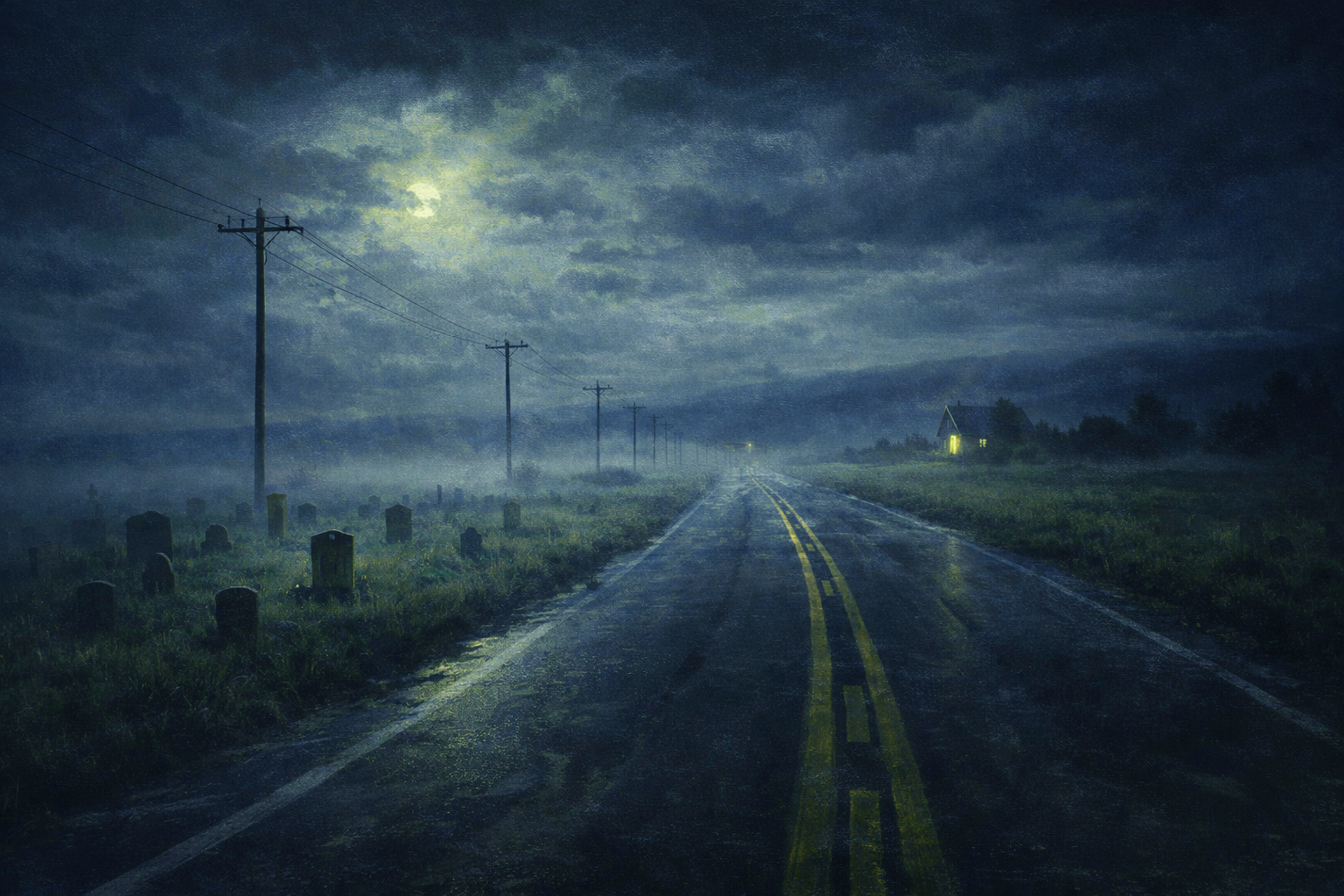
In American Gothic, the haunted house is often the landscape itself:
The desert remembers.
The river remembers.
The forest remembers.
The road remembers.
The town remembers.
American ghost stories often take place in wide, open spaces, which creates a very specific kind of fear.
Not the fear of being trapped.
But the fear of being alone.
European Gothic says:
Something is in here with you.
American Gothic says:
Anything might be in here and out there.
American Ghosts Are Often About History
Many American ghost stories are stories about history that has not been resolved.
Not just personal history, collective history:
Slavery.
War.
Expansion.
Displacement.
Gold rush towns.
Industrial accidents.
Forgotten communities.
Lost towns swallowed by forests or deserts.
Neighborhoods erased by highways.
Storms. Floods. Fires.
The American ghost often represents something that a place is trying to forget.
That is why so many American ghost stories begin with someone arriving somewhere new: a new house, a new town, a new job, a road trip, a frontier, a mine, a radio station, a hotel, a farm… only for a slowly realization to arise.
This place already has a brutal story.
The story is unfinished.
It is lingering in the soil.
And lurking past the treeline.
Movement
vs.
Inheritance
European Gothic is often about inheritance: you inherit the castle, the title, the curse, the family secret.
American Gothic is often about movement: you arrive, you travel, you pass through, you start over, you reinvent yourself. But the ghost… is still there.
So the American Gothic story often becomes a story about this realization:
You can move to a new place,
but you cannot move away from the past.
Because in America, the past is not only behind you.
It is often under you.
And it follows.
Why This Matters for Storytelling
This is why American ghost stories often feel like road stories, frontier stories, small town stories, Southern Gothic, Western Gothic, urban Gothic, stories about strangers arriving somewhere, stories about places that feel wrong before anything happens, stories where the setting is not just a setting, but a presence.
In American Gothic, the ghost is not always a person.
Sometimes the ghost is a town, a mine, a river, a house, a memory, a story people stopped telling, a history book that was never written.
Gothic Americana
This is where many American Gothic stories live, in what is called Gothic Americana.
Not castles, but farmhouses.
Not ruins, but abandoned towns.
Not ancient aristocrats, but strangers, workers, performers, travelers, drifters, families.
Not stone corridors, but highways, deserts, forests, river towns, and cities built on top of older cities.
In these stories, the question is not,
“What monster lives in this castle?”
The question is,
“What happened here?”
American ghost stories are not only about the dead.
They are about memory.
They are about place.
They are about history that refuses to stay buried.
EXPLORE THE HAUNTED CITY
where Gothic literature remains undead within the architecture of haunted cities.
The Haunted City Tradition
Gothic Horror: Fear of the Unknown
Essential Haunted City Books