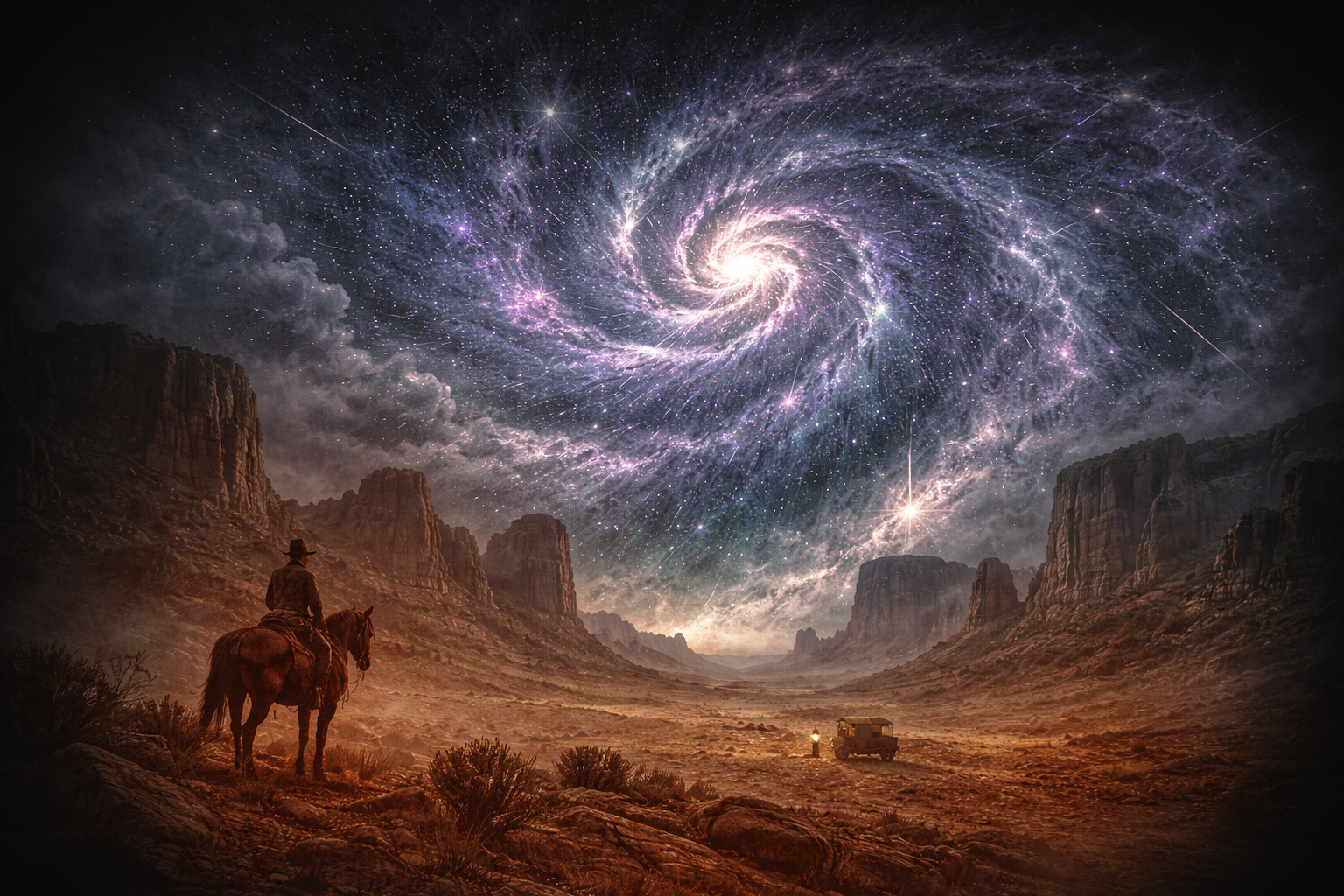
Cosmic Horror
on the
Frontier
The American frontier is often portrayed as a place of conquest and expansion. In traditional Western mythology, the wilderness exists to be explored, mapped, and ultimately brought under human control. Yet the vast landscapes of the West also suggest a different possibility. Across endless deserts, abandoned mines, and isolated settlements, the land itself feels ancient and indifferent to human ambition. The horizon stretches so far that the concerns of individuals begin to appear small against the scale of the environment. This sense of insignificance lies at the heart of Cosmic Horror.
Within the Weird Western tradition, cosmic horror introduces an even deeper unease. Instead of ghosts or curses, the frontier may conceal forces so vast and ancient that human history becomes little more than a brief interruption in the land’s true story.
*
The Cosmic Perspective
Cosmic horror is a literary tradition that emphasizes humanity’s limited understanding of the universe. In these stories, the world is not governed by human meaning or morality but by vast forces that exist far beyond human comprehension. This tradition is most often associated with H. P. Lovecraft, whose stories imagined ancient entities and forgotten civilizations lurking beneath the surface of ordinary reality.
In Lovecraft’s work, the discovery of these hidden truths often leads not to heroism, but to a profound sense of unease. Humanity’s place in the universe appears far smaller and more fragile than previously imagined.
*
The Frontier as a Cosmic Landscape
While Lovecraft frequently set his stories in decaying New England towns, the American West offers an equally powerful setting for Cosmic Horror.
The frontier landscape is defined by distance and silence:
Deserts stretch for hundreds of miles.
Mountain ranges hide unexplored caverns.
Old mining towns sit abandoned beneath immense skies.
In such places, the idea that something ancient might lie buried beneath the earth does not feel impossible. The frontier becomes a stage where human settlement appears temporary, and the land itself suggests a history far older than the civilizations built upon it.
Beneath immense desert skies, the frontier can feel less like a place conquered by humanity and more like a temporary outpost in an older world. Mines cut into mountains, tunnels burrow through stone, and every excavation suggests the possibility that something buried long ago might still be waiting.
*
Buried Histories
and
Hidden Depths
Cosmic Horror often emerges from the discovery of what lies beneath the surface:
Forgotten tunnels, ancient ruins, and abandoned settlements hint at layers of history that predate the present moment.
In frontier landscapes shaped by mining, excavation, and exploration, these buried histories become especially evocative. Every tunnel cut into a mountain, every shaft dug into the desert floor, carries the possibility that something unexpected might be uncovered.
The deeper one digs, the more uncertain the world becomes.
*
A Modern Exploration
The God in the Dirt is a modern literary example of this intersection between frontier mythology and cosmic horror.
Set in a desert town where buried histories begin to surface, the novel explores the unsettling possibility that the land itself may conceal forces far older than the settlement built upon it. When the cosmic perspective enters the Western landscape, the frontier becomes more than a historical setting; it becomes a place where human ambition collides with something vast and unknowable.
In this way, the story enters the imaginative territory known as the Dark Frontier, where Western mythology meets the strange and the cosmic.
*
Explore the Dark Frontier
Essential Weird Western Books
What is the Dark Frontier?
The Weird Western Tradition