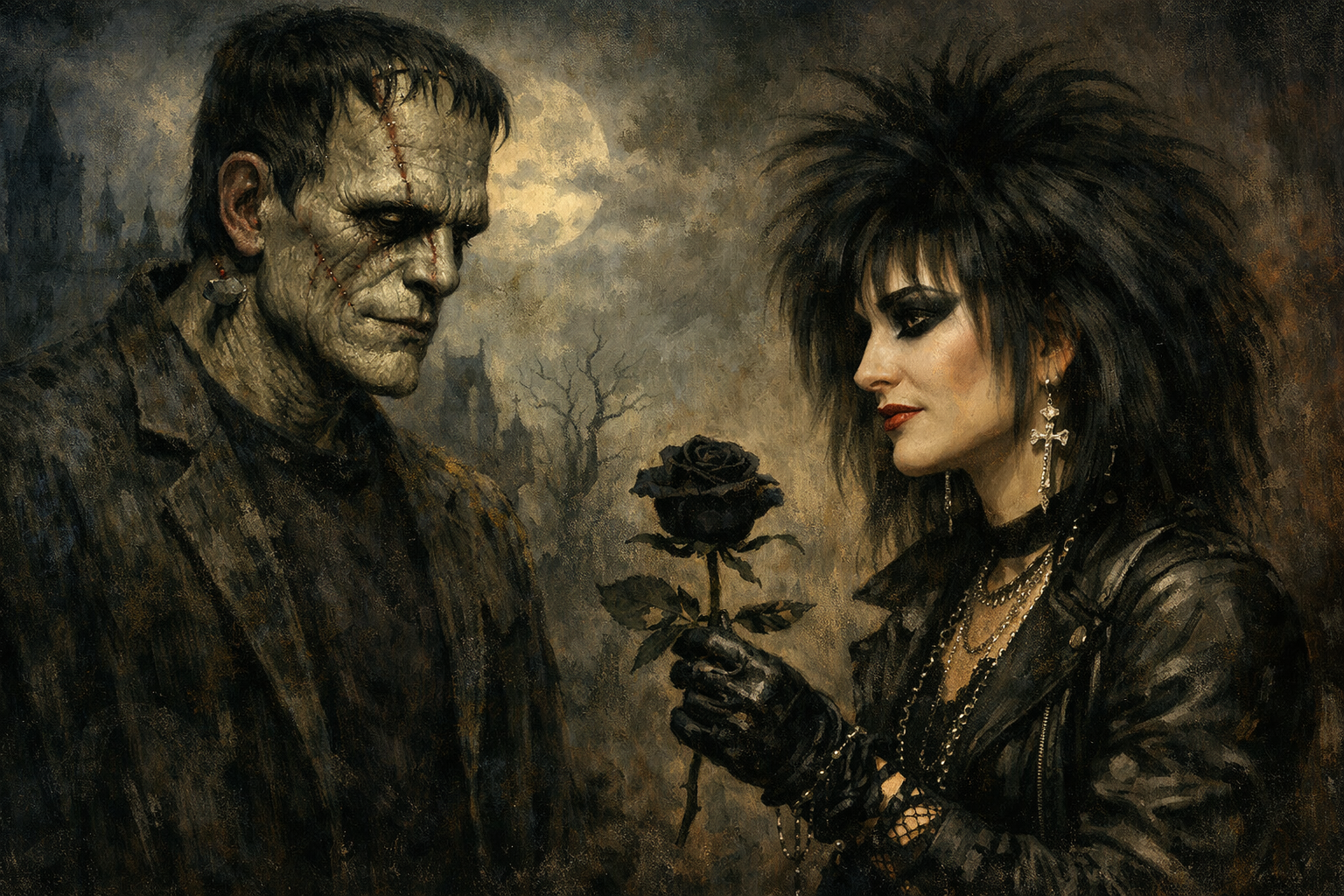
Gothic
vs.
Goth:
What’s the Difference?
People often confuse Gothic literature with Goth culture, but the two are not the same thing. They share an aesthetic lineage, but they are separated by centuries, purpose, and philosophy.
Gothic literature is a storytelling tradition that began in the 18th century. It explores fear, the unknown, memory, ruin, and the psychological weight of the past. Gothic stories are not simply dark, they are haunted by history, by moral questions, and by the feeling that something old and unresolved is still alive beneath the surface of the present.
Goth, on the other hand, is a modern subculture, a visual and musical movement that emerged in the late 20th century, associated with fashion, music, and aesthetics inspired by Gothic imagery.
In simple terms…
Gothic includes: Literary tradition, Castles, ruins, ghosts, memory, Psychological and moral fear, The past haunting the present, Edgar Allan Poe, Mary Shelley, Bram Stoker.
Goth includes: Modern subculture, Black clothes, music / fashion, Aesthetic and identity, The present expressing mood, Bauhaus, Siouxsie and the Banshees, The Cure.
You can dress Goth without ever reading Gothic literature, and you can write Gothic literature without wearing black.
Gothic is
a literary mode.
Goth is
a cultural style.
Gothic literature asks:
What haunts us?
What do we inherit?
What refuses to stay buried?
What is the cost of memory?
What happens when the past is not past?
This is why Gothic stories often take place in:
Old houses.
Ruined towns.
Remote landscapes.
Haunted cities.
Places where history feels alive.
Gothic literature is not about vampires, black clothing, or darkness for its own sake.
It is about the pressure of the unseen on the living.
Gothic stories are about people standing in the present while something from the past (a memory, a place, a decision, a ghost, a guilt) refuses to leave them alone.
The Gothic is not the monster.
The Gothic is the haunting.
It is about atmosphere, memory, guilt, inheritance, and the fear of what we do not understand.
In that sense, Gothic literature is not a genre.
It is a way of looking at the world.
Authors Often Associated with Gothic Literature
Edgar Allan Poe
Mary Shelley
Bram Stoker
Shirley Jackson
William Faulkner
Flannery O’Connor
These writers were not “Goth.” They were deeply Gothic.
Where My Work Fits
The stories I write are part of a tradition sometimes called Gothic Americana, where the Gothic is not found in castles, but in deserts, river towns, highways, forgotten theaters, and strange corners of American history.
In these stories, the haunted house becomes a saloon, a radio station, a mine, a highway, a memory.
The monsters are not always monsters.
Sometimes, they are inheritance.
Sometimes, they are belief.
Sometimes, they are us.