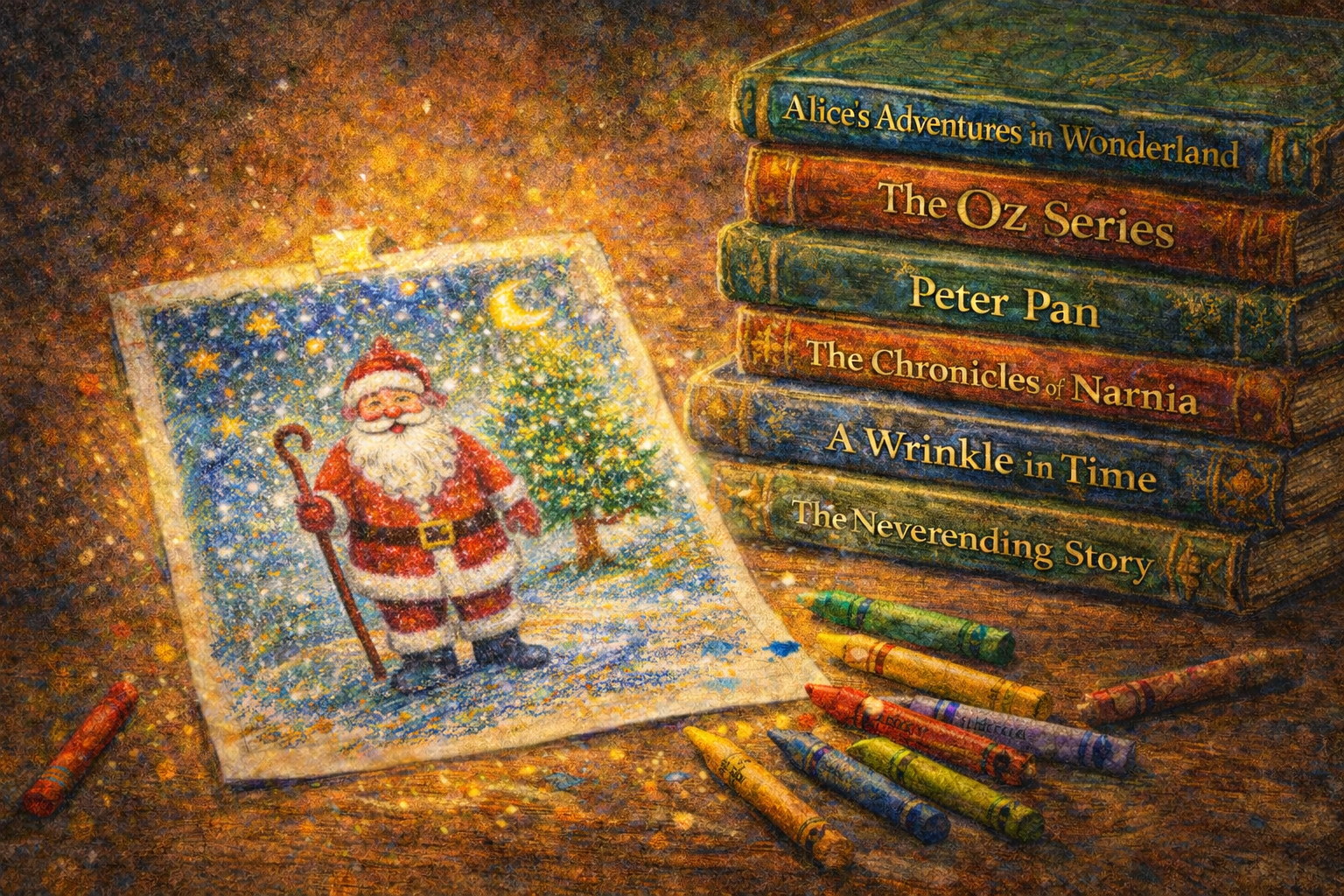
Alice’s Adventures in Wonderland
Lewis Carroll (1865)
Few stories capture the strange logic of childhood imagination as vividly as Alice’s Adventures in Wonderland. What begins with a simple act of curiosity (following a rabbit down a hole) quickly transforms into a dreamlike world governed by playful absurdity.
Carroll’s story helped establish a key idea within childhood fantasy: that the magical world does not need elaborate explanation. It simply unfolds as naturally as a dream.
The Oz Series
L. Frank Baum (1900-1920)
Beginning with The Wonderful Wizard of Oz, L. Frank Baum’s Oz series created one of the first expansive fantasy worlds written specifically for children. Across multiple books, Dorothy and her companions return to a land where courage, friendship, and curiosity matter more than destiny or prophecy.
In The Wonderful Wizard of Oz, Dorothy’s journey into the Land of Oz begins not with prophecy but with circumstance. A tornado carries her from Kansas into a bright and unfamiliar landscape filled with unlikely companions and hidden courage.
Baum’s story helped shape the tradition of American childhood fantasy, where ordinary characters discover bravery, loyalty, and resilience through adventure.
Peter Pan
J. M. Barrie (1911)
With Peter Pan, Barrie introduced one of the most enduring myths of childhood itself. Neverland is not merely a place but an extension of imagination, a world where childhood refuses to fade and where adventure is always waiting just beyond the ordinary.
The story explores both the beauty and the melancholy of growing up, making it one of the most emotionally complex works in the tradition.
The Chronicles of Narnia
C. S. Lewis (1950–1956)
Lewis expanded the scope of childhood fantasy by combining myth, moral allegory, and epic adventure. In The Lion, the Witch and the Wardrobe, a wardrobe becomes the gateway to an ancient kingdom where children must confront both wonder and responsibility.
The series demonstrated how child protagonists could stand at the center of vast mythological worlds while still retaining the intimacy of childhood perspective.
A Wrinkle in Time
Madeleine L’Engle (1962)
Blending science fiction with spiritual and emotional themes, A Wrinkle in Time presents a cosmic adventure guided by the courage and determination of a young girl searching for her father.
L’Engle demonstrated that childhood fantasy could explore vast ideas (science, morality, and love) while remaining rooted in the emotional perspective of young characters.
The Neverending Story
Michael Ende (1979)
In The Neverending Story, imagination itself becomes the subject of the narrative. A lonely boy discovers a book that slowly draws him into the world it describes, revealing that storytelling has the power to sustain entire universes.
Ende’s novel deepened the philosophical dimension of childhood fantasy, exploring how imagination shapes identity and reality.
Fantastical Nature
Paul Glyph (2025)
In Fantastical Nature: A Family Tale with Complications, the tradition appears in the form of a child’s drawing that awakens something far older than the family expects. What begins as a quiet creative moment gradually transforms an ordinary home into the threshold of a far larger mystery.
Like the stories that precede it, the magic does not arrive through spectacle alone. It appears through curiosity, creativity, and the willingness to explore what lies just beyond the ordinary world.
*
Explore Fantastical Childhood
What Makes Children’s Fantasy Magical?
The Child-Centered Fantasy Tradition
Childhood Imagination
Explore different aspects of this tradition with stories like Fantastical Nature that continue to carry its spirit.
Essential
Children’s
Fantasy
Books
Across generations, certain fantasy stories have returned again and again to the perspective of childhood. These books do more than entertain young readers; they shape the imaginative landscape through which entire generations first encounter wonder.
While fantasy literature spans countless worlds and traditions, a small number of works have become especially influential in defining the tradition of child-centered fantasy. Each of these stories begins with a familiar moment (a child noticing something unusual) and gradually opens the door to a much larger world.